
AVOID UNNECESSARY TAXES WHEN SELLING REAL ESTATE
PRESERVE AND BUILD WEALTH WHILE SAVING MONEY ON UNNECESSARY TAXES.
A special government-approved technique allows you to avoid capital gains tax when selling real estate that is not your primary residence. This technique is the last remaining tax shelter for investment real estate owners
THE TAXMAN IS WAITING
In 1997, Congress passed new, generous rules that effectively eliminate capital gains tax on the sale of most people’s primary residence. But what happens if you are selling any other classification of real estate investment property, business property, vacation home, etc.? You will be taxed on your profit unless you use the IRS Section 1031 Exchange Rule.
WHAT IS AN EXCHANGE?
Use of the word “exchange” is essentially a legal fiction. What happens in practice is a sale and subsequent purchase are made interdependent using the 1031 exchange technique and special paperwork. These exchanges are often called Starker Exchanges, Like-Kind Exchanges or Tax-Deferred Exchanges, but a better name would be The Investment Roll-Over Rule because all of your money rolls-over into a new purchase.
WHEN SHOULD YOU USE THIS TECHNIQUE?
Anytime you are selling real estate that is not your primary residence and you are faced with an onerous capital gains tax, use the 1031 exchange technique instead of simply selling. Virtually any new purchase will qualify as your replacement property. The diagram below will give you the idea.

WHY SHOULD YOU DO AN EXCHANGE?
When you purchased the property, did it occur to you that you had made the Government a silent partner who would want to share the profits? Think of how long it would take you to save money lost to taxes and to rebuild that hard-earned equity. Fortunately, you can avoid this scenario using the Exchange Technique.
HOW DO YOU DO A BASIC EXCHANGE?
Your sale and subsequent purchase must take place within a 180 day period beginning on the day you close on the sale of your relinquished property. Special paperwork links these two events together and allows them to qualify as an exchange. Sale proceeds must be deposited in a special account during the period between the sale and purchase. Exchange Rules require that you designate a Qualified Intermediary to perform these services. Follow the Diagram and explanation below to see how it works.

- The Exchanger enters into a Sale Contract to sell the relinquished property with anyone who wishes to purchase the property.
- The Exchanger enters into an Exchange Agreement with a Qualified Intermediary, such as New England 1031, LLC.
- The Exchanger then assigns the executed Sale Contract to the Qualified Intermediary.
- At the closing for the sale of the relinquished property, the Exchanger deeds the relinquished property directly to the Buyer, and the proceeds of the sale are deposited with the Qualified Intermediary.
- Within 45 days after closing on the relinquished property, the Exchanger identifies possible replacement properties to the Qualified Intermediary.
- The Exchanger enters into a Purchase Contract for whatever replacement property Exchanger wishes to acquire.
- The Purchase Contract between the Exchanger and the Seller is then assigned to the Qualified Intermediary.
- The Closing for the purchase of the replacement property must take place within 180 days of the closing on the sale of the relinquished property (Step 4). At the closing for the purchase of the replacement property the Seller deeds the replacement property directly to the Exchanger, and all the money held by the Qualified Intermediary is used to acquire the replacement property.
- The exchange has been completed and no tax is owed. What really occurred is a sale and subsequent purchase that were made interdependent through use of the 1031 exchange technique and a Qualified Intermediary.
ARE THERE ANY RULES OR REQUIREMENTS?
There are three requirements your transactions must meet in order to have a completely non-taxable event.
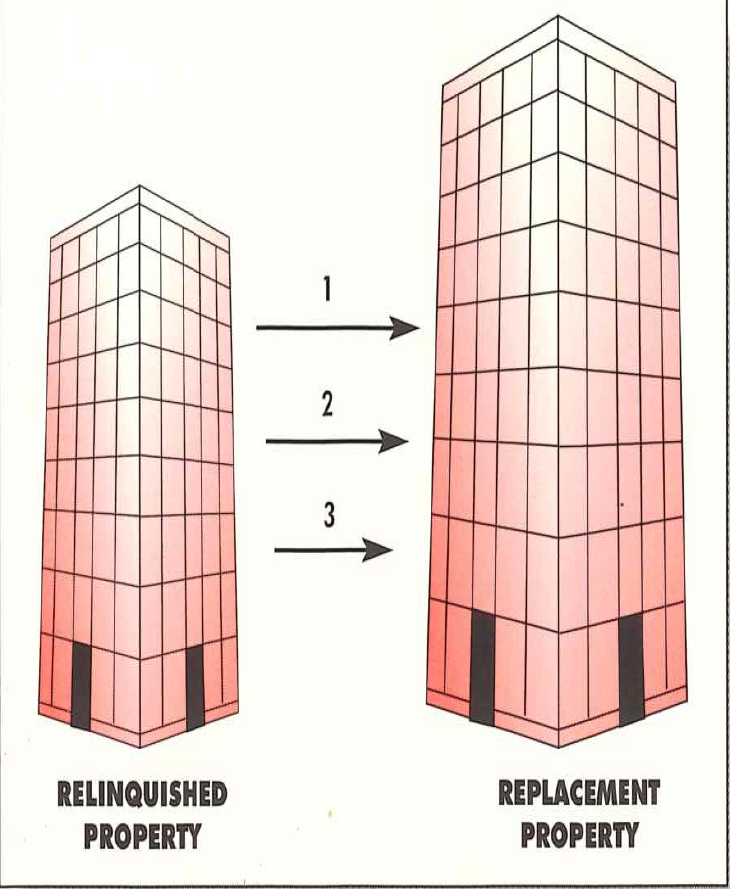
- Purchase a property of equal or greater value than the property that was sold.
- Reinvest all sale proceeds.
- Equal to or greater amount of debt on the replacement property than on the relinquished property (new or assumed mortgage on replacement property).
However, the 1031 exchange technique is not all or nothing. If desired, it is possible to get some cash from the sale of the relinquished property (which will be taxable) provided it is done the right way. The exchange technique can be flexible to meet certain needs.
A SUMMARY OF EXCHANGE BENEFITS
- You will save significant money you worked hard to earn. Tax money is lost forever. A 1031 exchange makes this loss unnecessary.
- It is true you must purchase something new to avoid the tax, BUT the Government essentially helps subsidize your new purchase with your tax savings and therefore, your purchasing power is significantly increased.
WHAT SHOULD YOU LOOK FOR IN AN INTERMEDIARY?
There are three watchwords when choosing a qualified intermediary: experience, service, and security.
Our Senior Exchange Consultant is a nationally-recognized Exchange Specialist who advises eight State Bar Associations and the American Land Title Association on 1031 exchange matters. He is both a Qualified Intermediary and Attorney with real-world exchange experience, not some bureaucratic functionary.
Your Exchange Documents are custom-prepared and securely emailed. You have the comfort of knowing their content has passed IRS scrutiny.
We employ a rigorous dual signature account structure with our trustee bank with segregated accounts to ensure your money is safe during the exchange.
As we have for many before you, let us show you how to successfully sell and buy non-primary residence property and avoid unnecessary taxes.
EXCHANGE TERMS AND DEFINITIONS
Starker The famous case permitting delayed exchanges sell first; buy later. A Starker Exchange is now part of the tax code.
Relinquished Property The property you initially own that is sold to begin the exchange.
Replacement Property The property you subsequently purchase to complete the exchange.
Like-Kind This simply means selling and buying non-primary residence real estate. You can’t sell real estate and buy stocks and have it qualify as an exchange.
Identification Within 45 days of selling, you narrow your possible purchase choices to three. If you intend to purchase more than three properties, there are special rules.
Safe Harbors Critical elements for doing an exchange correctly to assure favorable tax treatment. Having an Intermediary is one of them.
Constructive Receipt You cannot have unilateral control of your sale proceeds between the sale and subsequent purchase.
We Take the Pain Out of Capital Gain
Specialty Exchanges
In addition to a Standard Exchange (sell, then buy), there are two specialty exchanges that address certain specific needs. While they are not common – and do require additional steps, paperwork and expense – they can be critical to your real estate investment intentions when you find a need for either strategy.
Reverse Exchange You might find an ideal replacement property for your Exchange, but you will need to agree to purchase it now or lose it. And you are not going to be able to sell your current property in time to do these transactions in the usual order of sell, then buy. A “Reverse Exchange” allows you to accomplish the needed practical order of buy, then sell – and have it properly qualify as an Exchange. When done correctly, this technique does have IRS approval.
Build-To-Suit Exchange (BTS) You may want to acquire vacant land and build something on it for use as your Replacement Property – and use your Relinquished Property sale proceeds to do both. Or your Replacement Property may be in need of various “improvements” and you would like to use some of those sale proceeds to do it. Can it be done? Yes. The “problem” is you cannot use Exchange proceeds to improve property you already own – and have that money qualify for Exchange treatment. The “improvements” will have to be done under ownership other than your own. A BTS Exchange makes this possible when done correctly.
New England 1031 – Our Unique GUARANTEE
Our Unique SATISFACTION GUARANTEE
The product of any service business is the service itself. And we pride ourselves in the quality and attentiveness of our service. If at the end of our Exchange Service for you, if either you – or any professional with whom we work on your behalf – honestly feel we have failed in the quality of our service – we will refund the Exchange Services Fee you have paid us. We know of no other Exchange Intermediary Service willing to make this promised Guarantee.
Our Free Exchange Education Gifts For You
The 10 Minute Exchange Primer. This document – written in plain English – will help you understand the important principles and rules of 1031 Exchanges. In just 10 minutes, you will know more about Exchanges than 95% of all real estate investors and professionals.
Our Proprietary Exchange Diagram. This one-page document we created both visually diagrams the steps of an exchange, but also describes them in writing. This diagram – coupled with our Exchange Primer – will send you to the head of the exchange classroom.
Formula For Calculating Monetary Exchange Savings. In order to reinforce for you the importance of using the Exchange technique, it can be very useful to know what you might otherwise have to pay in taxes if you just “sell outright”. While this formula is not a substitute for a precise calculation by an Accountant, it does show your “sorry story” of paying unnecessary taxes.
There is only one “catch” to receiving these helpful free exchange assets. You have to ask for them. To do so, simply email us at – info@newengland1031.com. We will be glad to send them to you – and we look forward to hearing from you.
 New england 1031